Guide · Nutrition
Whey Protein Powder: How to Use It for Muscle Training
Performance education — not medical advice. People with kidney disease, milk allergy, or clinician-directed protein limits should get individualized advice before using protein powders.
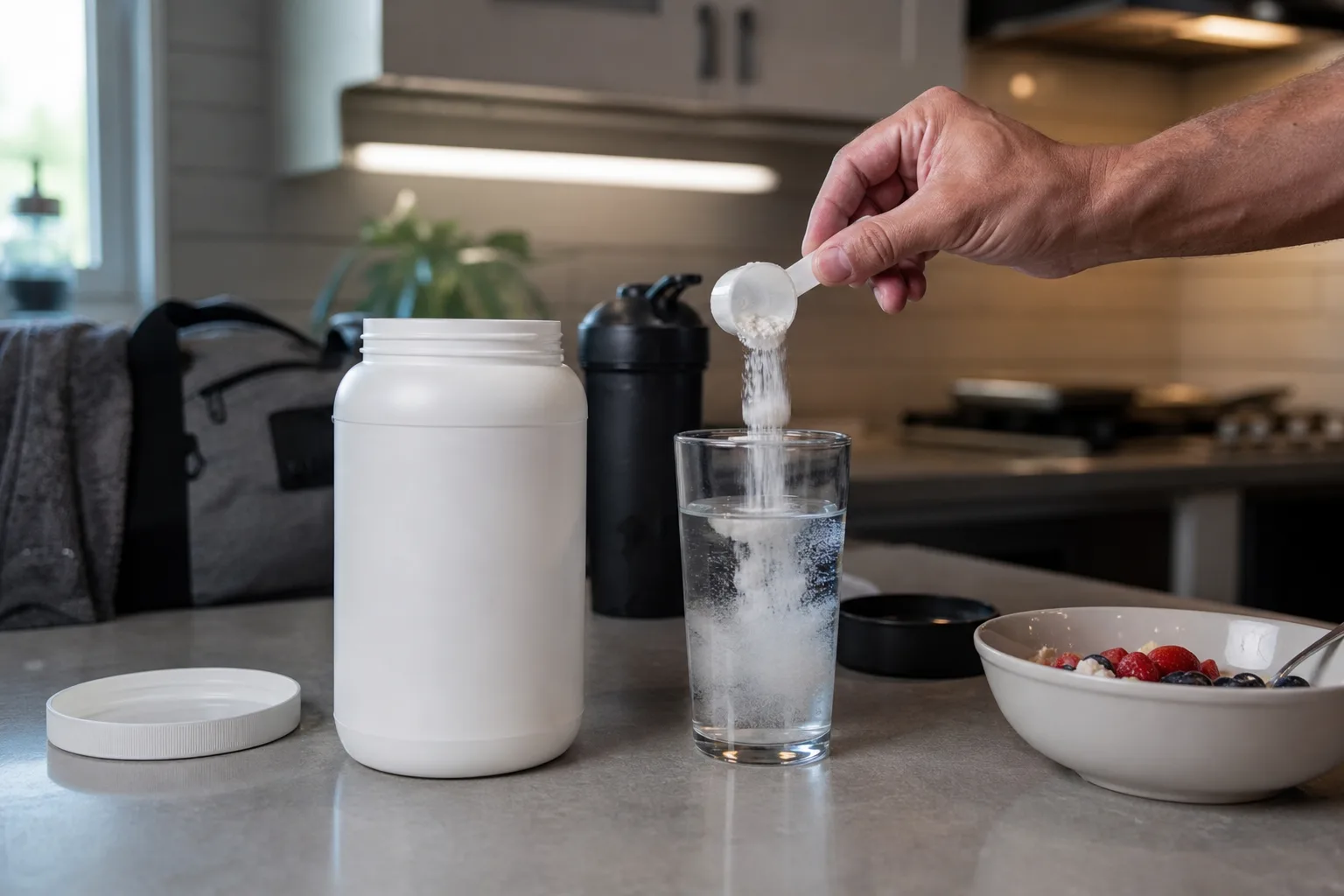
Direct answer: Whey protein powder is a convenient dairy-derived protein that helps generally healthy adults hit daily protein targets that support resistance training. It is not a steroid, not a hormone, and not required if food already covers your protein. Use scoops to close a gap — not to replace progressive overload.
What whey protein powder is (and is not)
Whey is the liquid fraction of milk remaining after casein coagulates in cheese-making. Manufacturers dry and concentrate that protein into powder. For lifters, the educational job of whey protein powder is straightforward: deliver high-quality protein with a complete amino-acid profile in a form that mixes quickly and digests relatively fast for many people.
Soft YMYL boundary: this guide is sports-nutrition education for generally healthy adults. It is not medical nutrition therapy, not allergy diagnosis, and not a treatment plan for kidney disease or eating disorders. Muslex does not sell powder here and does not quote checkout prices.
Deepen daily targets on the nutrition pillar, estimate needs with the protein calculator, and calm timing panic with the protein timing guide.
Search intent around whey protein powder usually bundles five jobs: define the product, pick a form, decide scoop count, avoid digestion problems, and separate protein convenience from magic claims. This page covers all five without turning into a storefront.
Concentrate, isolate, and hydrolysate
Form choice matters more than brand theater for most buyers.
| Form | Typical trait | Who often prefers it | Watch-outs |
|---|---|---|---|
| Whey concentrate | Lower processing cost; more lactose/fat left | Budget shoppers who tolerate dairy | May bother lactose-sensitive users |
| Whey isolate | More filtration; higher protein density | Less lactose or leaner macros | Usually higher cost per serving |
| Hydrolysate | Partially pre-broken; often ‘fast’ feel | Specialized digestion preference | Taste/price; not automatically more muscle |
For most healthy adults who lift, concentrate or isolate both work if total daily protein is covered. Processing novelty is not a hypertrophy cheat code.
Flavored vs unflavored
Flavored whey protein powder improves adherence for many people but adds sweeteners, flavors, and sometimes thickeners. Unflavored mixes into oats, yogurt, or savory cooking with fewer taste conflicts. Choose the version you will actually finish.
How much whey protein powder — and when
Start from daily protein, not scoop folklore. Sports-nutrition education commonly discusses roughly 1.6–2.2 g protein per kg bodyweight per day for many lifters pursuing muscle gain when energy intake is adequate. Food first; powder fills the remainder.
Worked education example: an 80 kg lifter aiming near 160 g protein/day who already eats ~110 g from meals might use about 40–50 g from powder (often 1–2 scoops depending on the label). Illustration only — not a prescription.
- Training days: a shake near the session is fine if it helps adherence.
- Rest days: protein targets still matter.
- Timing: daily total beats minute-level theater for most people.
Cross-check energy with the TDEE calculator and macros calculator. Protein without adequate energy and training is an incomplete plan.
Do you need whey on rest days?
If rest-day meals already hit your protein band, you do not need a mandatory shake. If appetite drops or cooking time disappears, whey protein powder remains a practical tool — recovery nutrition is weekly, not only post-workout theater.
How to read a whey protein powder label
- Protein grams per serving and serving size in grams of powder.
- Protein percentage of serving weight (rough quality proxy).
- Added sugars, sugar alcohols, and fiber — match to digestion and goals.
- Allergen statements (milk, soy lecithin, and others).
- Third-party testing badges if you compete in tested sport.
‘Mass gainer’ blends are not the same category as straight whey protein powder — they often add large carbohydrate loads. If your intent is protein density, do not accidentally buy a calorie bomb.
Amino spiking literacy
Historically, some low-quality products inflated nitrogen numbers with cheap amino acids. Prefer transparent brands, third-party tests when available, and labels where protein grams align with ingredient reality. Muslex cannot audit every SKU; treat skepticism as a buying skill.
Per-scoop cost thinking (education, no prices)
Without quoting store prices, compare value as: protein grams per serving ÷ servings per container, then sanity-check against concentrate vs isolate. Huge tubs can be economical if you will finish them before flavor fatigue. Tiny premium tubs can still be rational if digestion and adherence are better. Bulk intent keywords (for example 5 lb tubs) are about logistics, not magic muscle.
Digestion, lactose, and mixability
Common complaints include bloating, urgency, or chalky texture. Practical experiments for healthy adults: switch concentrate → isolate, change liquid (water vs lactose-free milk), reduce scoop size, or move the shake away from the hardest training bout. Persistent or severe symptoms, rash, or breathing issues are medical — not ‘gut training.’
Mixability improves with micronized powders, a shaker ball or blender, and enough liquid. Clumps are an inconvenience, not proof the product ‘does not work.’
Common myths and mistakes
| Claim | Education stance | Better move |
|---|---|---|
| “Whey is basically a steroid” | False category error | Treat as food-derived convenience protein |
| “More scoops = faster muscle” | Surplus beyond needs is not magic | Hit a sensible daily band; train hard |
| “Must drink within 30 minutes” | Overstated for most | Daily total + consistency |
| “Plant protein never works” | False | Totals and amino pattern matter |
| “Whey replaces sleep and overload” | False | See progressive overload and sleep |
| “Women should avoid whey” | No automatic ban for healthy adults | Same protein logic; clinical cases → clinician |
Boundaries vs casein, blends, plant proteins, and creatine
Whey digests relatively quickly for many people; casein is slower; blends mix both. Neither is pharmaceutical ‘anabolism.’ Cottage cheese, yogurt, eggs, fish, meat, tofu, and legumes remain valid. Creatine monohydrate is a separate lane — amino acids vs phosphocreatine support. See creatine monohydrate.
Practical parameter table
| Parameter | Education range / note | Boundary |
|---|---|---|
| Daily protein (many lifters) | ~1.6–2.2 g/kg (context-dependent) | Clinical conditions → clinician |
| Typical scoop protein | Often ~20–25 g (label-dependent) | Always read your label |
| Mix liquid | Water or milk per taste/macros | Milk adds calories/lactose |
| Storage | Cool, dry, sealed | Discard if spoiled |
| Role | Convenience protein | Not a training program |
| Stimulants | Plain whey should not feel like pre-workout | Check label if sleep suffers |
Sample week without obsession
A practical pattern for many lifters: protein at each main meal, optional whey protein powder on the two hardest training days plus one rushed workday, and food-only on a calmer weekend day if totals still land. Track weekly training quality — bar speed, set completion, soreness pattern — not shake perfectionism. If bodyweight goals matter, revisit TDEE monthly rather than changing scoops daily.
Buyer decision list (education, no checkout)
- Confirm food-first protein is insufficient or inconvenient.
- Pick concentrate vs isolate by lactose tolerance and budget.
- Check protein grams per scoop and recognizable ingredients.
- Match flavor/sweetener to adherence.
- If you compete tested, learn how certification badges work via Informed Sport education.
- Keep training, sleep, and energy intake as the real drivers.
Want an educational shortlist discussion? Ask Muslex — still no cart.
When to ask a clinician (Soft YMYL)
Speak with a qualified clinician if you have diagnosed kidney disease, are pregnant or breastfeeding, have known milk allergy, get unexplained swelling or breathing issues after dairy proteins, or have been told to restrict protein. Persistent GI distress is a reason to change product or seek care — not to force bigger scoops.
Travel, busy weeks, and adherence tactics
Whey protein powder earns its keep on weeks when cooking collapses: late meetings, travel days, or double sessions. Pack single-serve bags or a small tub, a shaker, and a bottle of water. Airport security is usually fine with sealed powder, but rules vary — keep original labels when possible. If refrigeration is unavailable, water mixes remain the default; UHT milk cartons are optional calories.
Adherence beats perfection. A plain shake plus fruit is still a protein-containing meal. If sweet flavors create cravings that derail fat-loss phases, switch to unflavored in savory soups or oatmeal. If appetite is huge in a surplus, powder can still help hit protein without forcing another large meat serving.
Notes for women who lift
Healthy adult women can use whey protein powder with the same logic as men: daily protein first, scoops as convenience. It will not automatically “bulk you like a bodybuilder.” Progressive overload and energy surplus drive visible size. Pregnancy, breastfeeding, or clinical diet restrictions need clinician guidance — this page is not clearance.
Related training context: strength training for women over 40.
Quality red flags when shopping
- Protein claims that do not match the nutrition panel math.
- Endless proprietary blends hiding protein sources.
- Miracle recomposition promises on the front label.
- No allergen statement on a milk-derived product.
- Seller photos that look reused across unrelated brands.
Case study: closing a 45 g gap
Jordan eats roughly 115 g protein from meals and needs about 160 g on training days. Two scoops providing ~22 g each close the gap without another grocery run. On rest days Jordan cooks a larger lunch and uses one scoop or none. Weekly lifting quality — completed sets near target RPE — matters more than whether the shake was pre- or post-session. Use RPE 8 literacy to keep training honest while nutrition stays simple.
FAQ
What is whey protein powder?
Whey protein powder is a concentrated dairy protein made from whey left after milk is processed into cheese or similar products. Lifters use it as convenient protein — not as a drug or hormone.
How much whey protein powder should I take per day?
There is no universal scoop prescription. Set total daily protein first — often roughly 1.6–2.2 g per kg for many lifters in education summaries — then use scoops to fill the gap after food. Use the Muslex protein calculator.
Is whey protein powder better than food?
Not better — more convenient. Whole foods can cover needs. Powder helps on busy days, travel, or low appetite after hard training.
Whey concentrate vs isolate — which should I buy?
Concentrate usually keeps more lactose and fat; isolate is more filtered with higher protein density and less lactose. Choose by digestion, budget, and label — not marketing.
Can lactose-intolerant people use whey protein powder?
Many with mild sensitivity prefer isolate. True milk allergy or severe intolerance needs clinician guidance and often non-dairy options. This page is not allergy medical advice.
Does whey protein powder build muscle by itself?
No. Progressive training, total protein and energy, and sleep drive adaptation. Powder is optional convenience.
When should I drink whey protein powder?
Whenever it helps daily protein. Peri-workout timing is flexible for most lifters.
Is whey protein powder safe every day?
For generally healthy adults, food-like protein powders are commonly used daily. Kidney disease, ordered protein limits, or allergy history need clinician advice first.
Safety boundary
- Generally healthy adults cleared for resistance training.
- Milk allergy or protein restriction: clinician first.
- No peptides, SARMs, or anabolic steroids on Muslex.
- Powder is optional; training and total diet dominate.