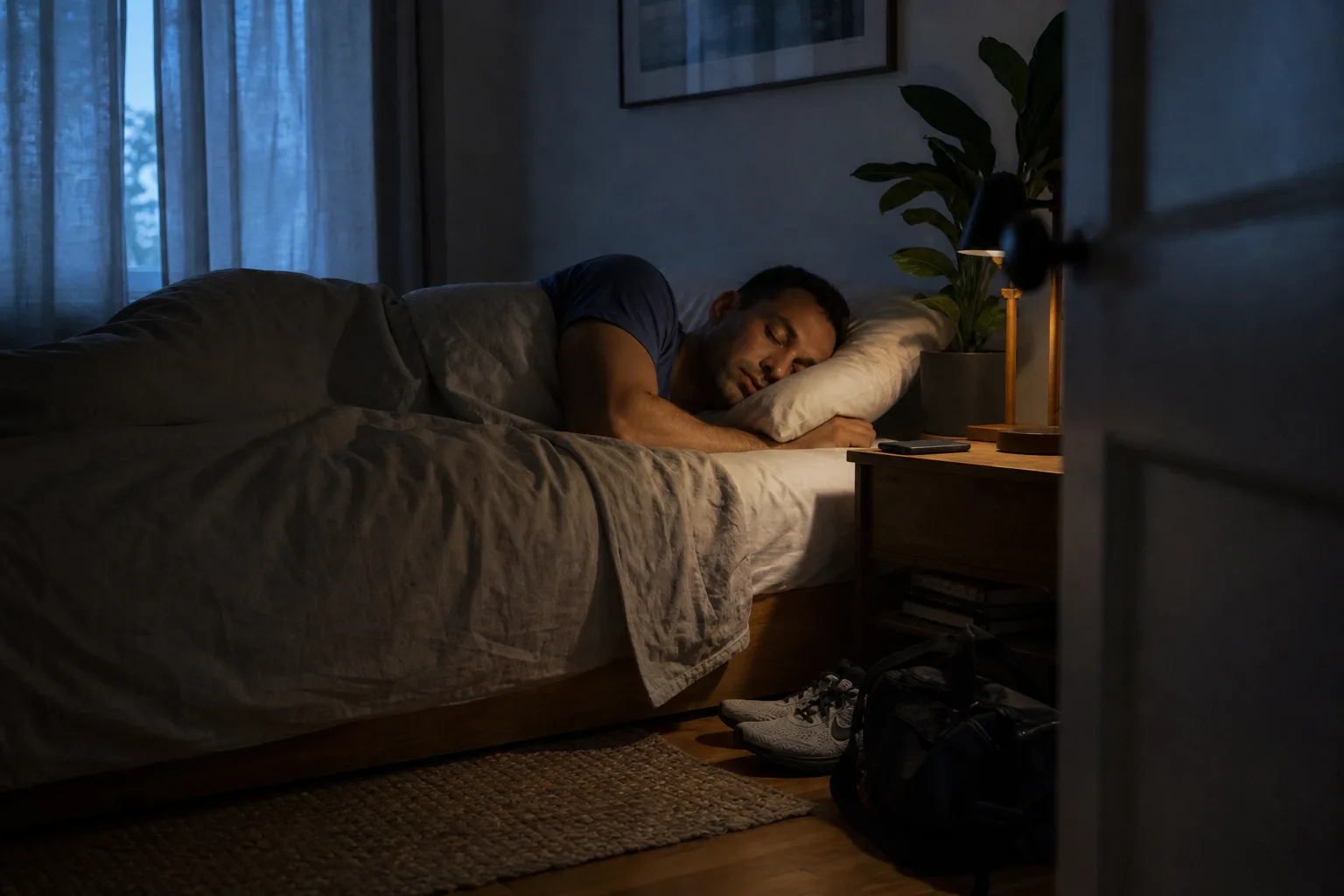
Sleep for training performance
Sleep for Training Performance
Performance education — not medical advice. Stop and seek professional care if you have sharp pain, dizziness, chest pain, or unexplained symptoms.
How sleep duration and consistency affect strength and hypertrophy — education for healthy lifters, not sleep-disorder diagnosis or medication guidance.
Why sleep belongs in a lifting site
Sleep is one of the highest-leverage recovery behaviors for training quality, mood, and willingness to progressive overload. Muslex covers sleep as a performance variable: protect a consistent window when you can, and reduce training stress when you cannot. We do not diagnose insomnia, apnea, or shift-work disorder, and we do not recommend prescription sleep drugs.
Public health primers such as the CDC overview of sleep and NHLBI sleep health pages are useful orientation links for general audiences. Athletic performance literature frequently associates short sleep with reduced output and higher perceived effort — treat that as a reason to autoregulate, not as a medical chart.
Duration targets vs perfectionism
Many adults are encouraged to land near a commonly discussed 7–9 hour nightly range. Individual need varies. Obsessing over a wearable score can become its own stressor. For lifters, the practical test is simple: are you recovering enough to add load or reps across weeks while life remains functional?
Consistency matters. A stable sleep midpoint often beats a chaotic mix of five-hour and ten-hour nights, even if the weekly average looks acceptable on paper.
Compare sleep scenarios for lifters
| Scenario | Training posture | Volume / intensity tweak | Notes |
|---|---|---|---|
| Stable 7–9 h | Normal progressive plan | Standard RPE targets | Still watch life stress |
| Short sleep 1–3 nights | Keep habit, reduce heroics | Drop accessory sets; cap RPE ~7–8 | Do not chase PRs |
| Chronic short sleep | Minimum effective training | Fewer hard sets; simpler split | Consider clinical sleep evaluation if impairing |
| Night shift | Protect dark sleep block | Train at best alert window; realistic volume | See night-shift guide |
| Travel / jet lag | Maintain movement patterns | Technique focus; lighter loads | Rebuild after schedule stabilizes |
Decision list for short-sleep weeks
- Protect the next available sleep opportunity (dark, cooler room, caffeine timing awareness) without turning this into unlicensed CBT-I therapy.
- Keep the training appointment when safe, but shrink hard sets first.
- Use RPE caps so ego loading does not fill the gap left by fatigue (RPE training: what RPE 8 means).
- Prefer compound pattern practice over adding new isolation volume.
- If daytime sleepiness is severe, or you suspect a clinical sleep disorder, seek appropriate clinical pathways (NHS/CDC-style care) — Muslex will not diagnose.
Shift work and irregular schedules
Night shift does not make hypertrophy impossible. It makes recovery bandwidth smaller. Anchor a protected sleep block, keep protein consistent across odd mealtimes, and accept slower progress than ideal sleepers. Full guide: can you build muscle on night shift?
Split choice should favor resilience: three full-body days often survive shift chaos better than a fragile six-day PPL. Return to How to choose a workout split when redesigning the week.
Adjusting training when sleep drops
Sleep debt raises perceived exertion. Loads that were RPE 7 can feel like RPE 9. Believing you must “push through percentages” is how technique breaks. Autoregulate with RPE, cut an accessory, or convert a session to technique work.
Pair with recovery literacy (recovery pillar, DOMS) so you do not confuse fatigue with a need for more random modalities.
Clinical boundary
Loud snoring with gasping, witnessed apneas, uncontrolled insomnia, or safety-critical sleepiness at work are clinical issues. Use public resources as a starting map (CDC, NHLBI) and seek clinicians. Muslex stays on the performance-education side.
High-yield sleep hygiene for lifters (non-clinical)
Simple environmental controls help many healthy adults: darker room, cooler temperature, and a consistent wind-down without treating every tip as mandatory dogma. Caffeine timing matters for some people — especially if late coffee pushes sleep onset past your training recovery needs. Bright screens can delay sleep for sensitive individuals; experiment rather than panic.
Track sleep enough to see patterns, not so much that anxiety about the score becomes the main problem. If wearable data conflicts with how you feel and how you lift, prioritize function: stable mood, safe bar path, and progressive logs.
Pair sleep work with nutrition basics. Under-eating while chasing PRs on short sleep is a common intermediate trap. Use educational TDEE/protein tools, then judge results over weeks. Link: Creatine monohydrate & protein targets.
How short sleep shows up under the bar
Common performance-education observations include higher perceived exertion at familiar loads, messier bracing, and less patience for controlled eccentrics. That is your cue to prune accessories and keep technique standards high rather than forcing a planned PR wave.
Team sport and tactical populations sometimes train through sleep restriction out of necessity. General Muslex readers usually have more choice. Use that choice: preserve the habit of showing up, reduce the dose, and rebuild intensity when sleep returns. Consistency across months beats one heroic week that digs a recovery hole.
When sleep and training conflict chronically, simplify the split, protect one consolidated sleep opportunity, and treat clinical symptoms as clinical — not as another programming puzzle to solve on a blog.
Strength sessions create their own arousal; if late training wrecks your onset latency, experiment with an earlier slot or a longer wind-down. Some lifters sleep fine after evening sessions — individual testing beats dogma. Keep caffeine timing as another n=1 experiment rather than a universal ban.
Across a training year, protect sleep like you protect squat technique: boring, consistent, non-negotiable on work nights when possible. The sleep pillar exists so training advice does not pretend fatigue is only a willpower problem.
Building a sleep budget around training
Treat sleep like training volume: protect a weekly budget, then allocate hard sessions where the budget is highest. If you know Thursday nights are short, move maximal lower-body work earlier in the week. Keep a consistent wake time on workdays even when bedtime drifts — circadian anchors matter for next-day RPE honesty.
When you are stuck near six hours, do not “make up for it” with stimulants and failure training. Cut junk sets, keep protein steady, and use RPE caps on compounds. See is 6 hours enough and night-shift training for constrained schedules. Clinical sleep disorders are outside this education page — seek care if breathing pauses, collapse-level fatigue, or unsafe sleepiness appear.
Alcohol late at night fragments sleep architecture even when total hours look fine on a wearable. If hypertrophy is the goal, treat late drinks as a recovery tax, not a neutral social default. Pair this pillar with the recovery and nutrition hubs so sleep is not isolated from food and deload decisions.
FAQ
Can I build muscle on six hours of sleep?
Some people make progress, especially beginners, but many will progress faster with more consistent sleep. Treat six hours as a signal to keep volume conservative.
Are naps a substitute for night sleep?
Naps can help alertness for some lifters; they rarely fully replace a consolidated night opportunity. Experiment carefully with timing so night sleep does not worsen.
Should I take supplements to fix sleep?
Muslex does not prescribe sleep medications or herbal protocols as treatment. Discuss supplements with a clinician if you have medical questions.
Is training late at night bad?
Individual. If late sessions wreck your sleep latency, move training earlier or reduce stimulants. If you sleep fine, evening training can be productive.
Safety boundary
- This page assumes you are a generally healthy adult cleared for resistance training.
- Persistent joint pain, numbness, swelling, chest pain, fainting, or post-injury issues: see a qualified clinician — Muslex does not diagnose or treat.
References
- CDC — About sleep.
- NHLBI — Sleep Health.
- NHS — How to get to sleep.
- Sleep & athletic performance literature entry (PubMed 28933712).
- ACSM — Physical activity guidelines resources.
- Editorial note: Summaries are for education on training performance. Individual response varies; this is not a clinical protocol.
Guide: Building muscle on night shift · Ask Muslex