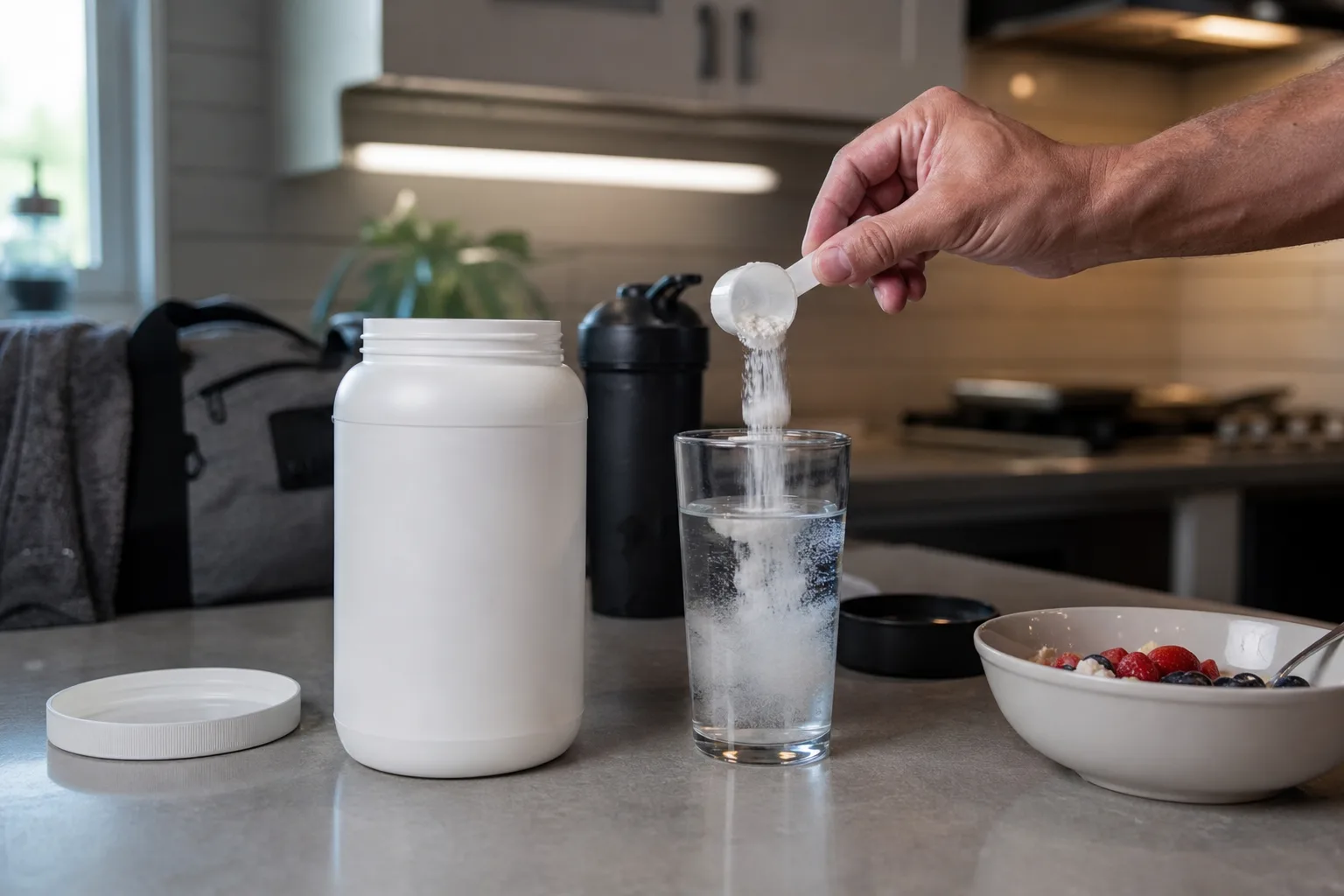
General sports nutrition education
Protein Targets & Creatine Monohydrate Basics
Performance education — not medical advice. Stop and seek professional care if you have sharp pain, dizziness, chest pain, or unexplained symptoms.
This pillar owns protein targets plus creatine monohydrate as the default form. For how much per day, loading vs daily, and hair-loss evidence, use the satellite guides — those keywords are not re-homed here.
What Muslex will and will not cover
Muslex teaches conventional, well-studied sports nutrition for generally healthy adults who lift: protein distribution, energy balance for muscle gain or maintenance, and creatine monohydrate. We do not provide medical nutrition therapy for disease, and we do not discuss prescription or non-conventional pharmacology outside our scope or prescription weight-loss drugs.
Position-stand style sports nutrition literature (for example the International Society of Sports Nutrition protein position stand: JISSN protein position stand) and government fact sheets (NIH ODS creatine: NIH ODS — Creatine) are primary anchors. Independent evidence libraries such as Examine’s creatine page help readers see research summaries with citations.
Protein intake ranges
For healthy adults doing resistance training, many evidence-informed summaries cluster around roughly 1.4–2.0 g/kg/day as a commonly discussed range for supporting muscle, with individual needs varying by energy deficit, age, and total training stress. Treat ranges as educational starting points — not prescriptions for medical conditions.
Use the protein calculator to explore gram estimates, then build meals you can repeat. Distribution across three or more protein-containing meals is a practical habit for many lifters; panic about a thirty-minute window is not required — see protein timing after workout.
Compare common nutrition levers
| Lever | Primary job | Typical education stance | Muslex tool / guide |
|---|---|---|---|
| Daily protein | Support remodeling & satiety | Hit a sensible g/kg range most days | Protein calculator |
| Energy balance | Gain, maintain, or cut | Small surplus for growth; deficit for fat loss with training preserved | TDEE calculator |
| Creatine monohydrate | Performance / training quality support | One of the most studied supplements in healthy adults | Creatine dosage |
| Protein timing | Convenience & distribution | Daily total > locker-room panic | Timing guide |
| Hydration & carbs around training | Session quality | Individual; fuel hard sessions | Practice-based, not medical |
Creatine myths evidence matrix
This is the Examine-style blade for Muslex: claim → public evidence entry point → practical stance → boundary. We cover conventional creatine monohydrate education only; anything outside that lane stays out of scope (see the coverage boundary above).
| Myth / claim | Evidence entry | Muslex education stance | Confidence | Boundary |
|---|---|---|---|---|
| “Creatine is a hormone drug” | NIH ODS Creatine; JISSN creatine position stand | False category error. Creatine monohydrate is a widely studied sports supplement, not a hormone drug. | High | Muslex stays on conventional creatine education |
| “You must load or it does nothing” | JISSN position stand; creatine dosage; Creatine loading vs daily dose | Loading saturates faster; ~3–5 g/day without loading usually saturates over ~3–4 weeks | High for saturation timeline in healthy adults | GI discomfort → skip aggressive loading |
| “Creatine causes hair loss” | One small DHT-related study + broader non-confirmation; Does creatine cause hair loss?; Examine creatine summaries | Broader evidence has not established clinical hair loss causation in healthy adults | Moderate (absence of strong causal proof ≠ proof of impossibility for every individual) | Personal dermatology concerns → clinician |
| “Creatine ruins kidneys in healthy people” | NIH ODS; JISSN safety discussions | In healthy adults it is among the most studied supplements; creatinine lab nuance exists | Moderate–high for healthy adults in studied doses | Kidney disease or medical conditions: ask a clinician before use |
| “You must chug extreme water or you dehydrate” | Sports nutrition practice + ODS context | Normal hydration habits matter; creatine is not a license for reckless fluid extremes or fearmongering | Practice-moderate | Medical fluid restrictions → clinician rules |
| “Only men benefit / women should avoid” | ISSN/ODS literature includes mixed-sex athletic contexts | Healthy adult women who lift can consider the same monohydrate education lane; individual response varies | Moderate | Pregnancy, clinical conditions, meds → clinician |
| “Any creatine form is dramatically better than monohydrate” | JISSN emphasis on monohydrate; Examine form comparisons | Monohydrate remains the default evidence-backed form for education pages | High as a default | Marketing novelty ≠ automatic superiority |
Independent research libraries such as Examine’s creatine page are useful for reading graded evidence with citations. Muslex links them for transparency — we do not sell creatine.
Creatine dosing comparison
Canonical numbers, phase table, and myths FAQ live on the creatine dosage page. Summary comparison below:
| Approach | Typical education pattern | Time to saturation (approx.) | Pros | Cons / notes |
|---|---|---|---|---|
| Daily low dose | ~3–5 g monohydrate most days | ~3–4 weeks | Simple; usually gentler GI | Slower full saturation |
| Loading then maintenance | Short higher-dose phase, then ~3–5 g/day | Days for many people | Faster saturation | More GI risk; not required |
| No creatine | — | — | Zero supplement cost/complexity | Forgo a well-supported performance aid; training still primary |
| Cycling on/off aggressively | Often unnecessary for healthy adults | N/A | — | Education default: consistent use beats ritual cycling unless clinician advises otherwise |
Body weight can rise modestly from water held in muscle as stores saturate — that is not the same as fat gain. Pair creatine education with progressive overload in the Progressive overload for lifters; powder does not replace hard sets.
Case week: nutrition operations for a gaining block
Educational example for a healthy adult intermediate on four training days. Numbers are illustrations, not medical nutrition therapy. Adjust from real-world weight and energy trends using the TDEE and protein calculators.
| Day | Training | Protein anchor idea | Energy bias | Creatine (if using) | Notes |
|---|---|---|---|---|---|
| Mon | Lower A | 3–4 protein feedings | Slight surplus | ~3–5 g | Carb a bit higher around session |
| Tue | Upper A | Same daily protein target | Slight surplus | ~3–5 g | Do not panic about exact minute timing |
| Wed | Off / walk | Keep protein steady | Near maintenance OK | ~3–5 g | Sleep priority |
| Thu | Lower B | Same | Slight surplus | ~3–5 g | Hydration normal |
| Fri | Upper B | Same | Slight surplus | ~3–5 g | Log lifts, not only macros |
| Sat–Sun | Off | Same weekly average | Flex meals OK | ~3–5 g | Consistency > perfect weekend spreadsheet |
Fat-loss weeks use the same protein anchors with a milder energy deficit and protected hard sets. Alcohol and 6-hour sleep crises belong in their guides — nutrition cannot out-supplement a destroyed recovery week.
Decision list for lifters
- Estimate energy needs with a transparent equation tool (TDEE) and adjust from real-world weight trends.
- Set a protein target in a commonly studied range and build repeatable meals.
- Progress training — nutrition supports overload; it does not replace it (Progressive overload for lifters).
- Consider creatine monohydrate if appropriate for a healthy adult after reading evidence summaries; ask a clinician if you have kidney disease or other medical concerns.
- Ignore black-market hormone marketing entirely — outside Muslex scope and against site policy.
Creatine monohydrate education
Creatine dosage (direct): about 3–5 g monohydrate daily for maintenance in healthy adults; optional loading ~20 g/day split for ~5–7 days. Full protocol table, myths, and FAQ: creatine dosage guide.
Creatine monohydrate is extensively studied for high-intensity performance support. ISSN and NIH ODS summaries are useful public entry points (JISSN creatine position stand; NIH ODS Creatine). Loading can saturate muscles faster; daily low-dose use also works over a few weeks — compare in Creatine loading vs daily dose.
Hair-loss fears usually trace to one small DHT study and online amplification. Broader evidence has not established that creatine causes clinical hair loss in healthy adults — see does creatine cause hair loss? and discuss personal dermatology concerns with a clinician.
Caffeine and creatine are often used in the same lifestyle. Education pages do not require theatrical separation rituals for every lifter; focus on total training quality, sleep, and consistent dosing. If you have anxiety, reflux, or medical limits on stimulants, that is a clinician or personal tolerance issue — not a reason to invent underground stacks.
What Muslex will not do: promise pharmaceutical-speed recomposition, or treat creatine as a cure for a bad program. Progressive overload, protein, and sleep remain the foundation. Creatine is an optional, well-studied support tool for many healthy adults.
Timing without panic
Meta-analytic and review discussions on protein timing (entry point: PubMed 24299050) generally support the idea that total daily intake and distribution matter more than a mythical thirty-minute window for most lifters. Eating protein in the hours around training remains a convenient habit.
Calculators and guides
- Protein calculator
- TDEE calculator
- Macros calculator
- Creatine dosage (how much + myths)
- Does creatine cause hair loss?
- Creatine loading vs daily dose
- Anabolic window & timing
- Alcohol and muscle growth
- Load & progressive overload pillar
Practical meal-building without perfectionism
Pick a protein anchor each meal (eggs, dairy, fish, poultry, lean meat, tofu, legumes plus complementary foods), add carbohydrate to fuel training, and include fats for overall diet pattern completeness. You do not need a perfect macro spreadsheet to grow — you need repeatable averages.
During fat-loss phases, keep protein toward the higher end of commonly discussed ranges and reduce energy mainly from carbohydrates and fats while preserving hard training as much as recovery allows. During gaining phases, a modest surplus beats reckless dirty bulk for most intermediates who care about sustainable progress.
Food quality still matters for general health, micronutrients, and adherence. Muslex will not turn this pillar into disease-diet counseling. If you have kidney disease, metabolic disease, or other clinical conditions, get individualized medical nutrition advice from qualified clinicians before using general sports ranges.
Myths we keep out of the lane
Muslex will not sell fear about food categories as toxins, will not promise pharmaceutical-speed recomposition, and will not dabble in underground hormone commerce. Creatine monohydrate myths get evidence links; hair-loss panic gets context; timing myths get total-daily-protein priority.
If a claim cannot be tied to a verifiable public source such as NIH ODS, JISSN, PubMed-indexed reviews, or transparent evidence libraries like Examine, it does not belong as a hard claim on this site. That discipline is part of Soft YMYL trust — not decoration.
Re-check progress every two to four weeks using body-weight trends, training logs, and adherence — not daily scale panic. Adjust energy intake in small steps while keeping protein steady.
Label reading helps when using protein powders: look for straightforward ingredients and doses you understand. Food-first approaches remain valid. The calculators on Muslex are educational estimators — adjust from real-world trends rather than treating outputs as prescriptions.
Finally, keep Soft YMYL humility: population ranges are not lab orders for your bloodwork. When health conditions exist, clinicians and registered dietitians (where relevant) outrank blog calculators. Muslex stays in performance education with open citations you can click.
When questions remain, use the inquiry form for education-oriented collaboration — not for medical diagnosis requests.
Weekly nutrition operations for lifters
Plan protein first, energy second, micronutrient-dense foods third. Most healthy adult lifters do well distributing protein across three to five feedings rather than chasing a mythical post-workout minute. Use the protein calculator as an educational starting range, then adjust for appetite, body-weight trend, and training stress.
Surplus for growth should be small enough that waist change stays controlled; deficit for fat loss should be mild enough that hard sets do not collapse. Cardio can fit beside lifting when calories and recovery are managed — see interference guidance in the guides cluster. Creatine monohydrate remains the best-supported conventional supplement topic on Muslex.
Travel weeks: keep a protein anchor at each meal, accept imperfect foods, and defend sleep. Do not rewrite macros into a new religion every hotel stay. Consistency across months beats perfect spreadsheets abandoned after ten days.
FAQ
Do I need whey protein?
No. Whey is convenient. Total daily protein from food or other supplements can work. Choose what you digest and can afford.
Is creatine a hormone drug?
No. Creatine monohydrate is a commonly studied sports supplement, not a hormone drug.
Should I eat at maintenance to build muscle?
Beginners can gain at maintenance or a small surplus. Intermediates usually need a slight surplus for faster tissue gain, with individual variation.
Can nutrition fix a bad program?
It cannot fully. Fix training structure and progressive overload in parallel with protein and energy basics.
Can women take creatine monohydrate?
Healthy adult women who lift can consider the same monohydrate education lane as men. Individual response varies. Pregnancy, clinical conditions, or medications require clinician guidance — Muslex does not provide medical clearance.
Do I need to separate creatine from coffee?
Most lifters do not need a rigid separation ritual. Prioritize consistent daily dosing, sleep, and training quality. If stimulants bother your stomach or sleep, adjust caffeine timing rather than abandoning evidence-based basics.
Safety boundary
- This page assumes you are a generally healthy adult cleared for resistance training.
- Persistent joint pain, numbness, swelling, chest pain, fainting, or post-injury issues: see a qualified clinician — Muslex does not diagnose or treat.
- Supplement mentions describe commonly studied products for performance education only. Muslex does not discuss prescription or non-conventional pharmacology outside our scope.
References
- JISSN — Protein and exercise position stand.
- JISSN — Creatine supplementation position stand.
- NIH ODS — Creatine fact sheet (Health Professional).
- Morton et al. — Protein supplementation & resistance training meta-analysis (PubMed 28698222).
- Schoenfeld et al. — Protein timing review entry (PubMed 24299050).
- Editorial note: Summaries are for education on training performance. Individual response varies; this is not a clinical protocol.