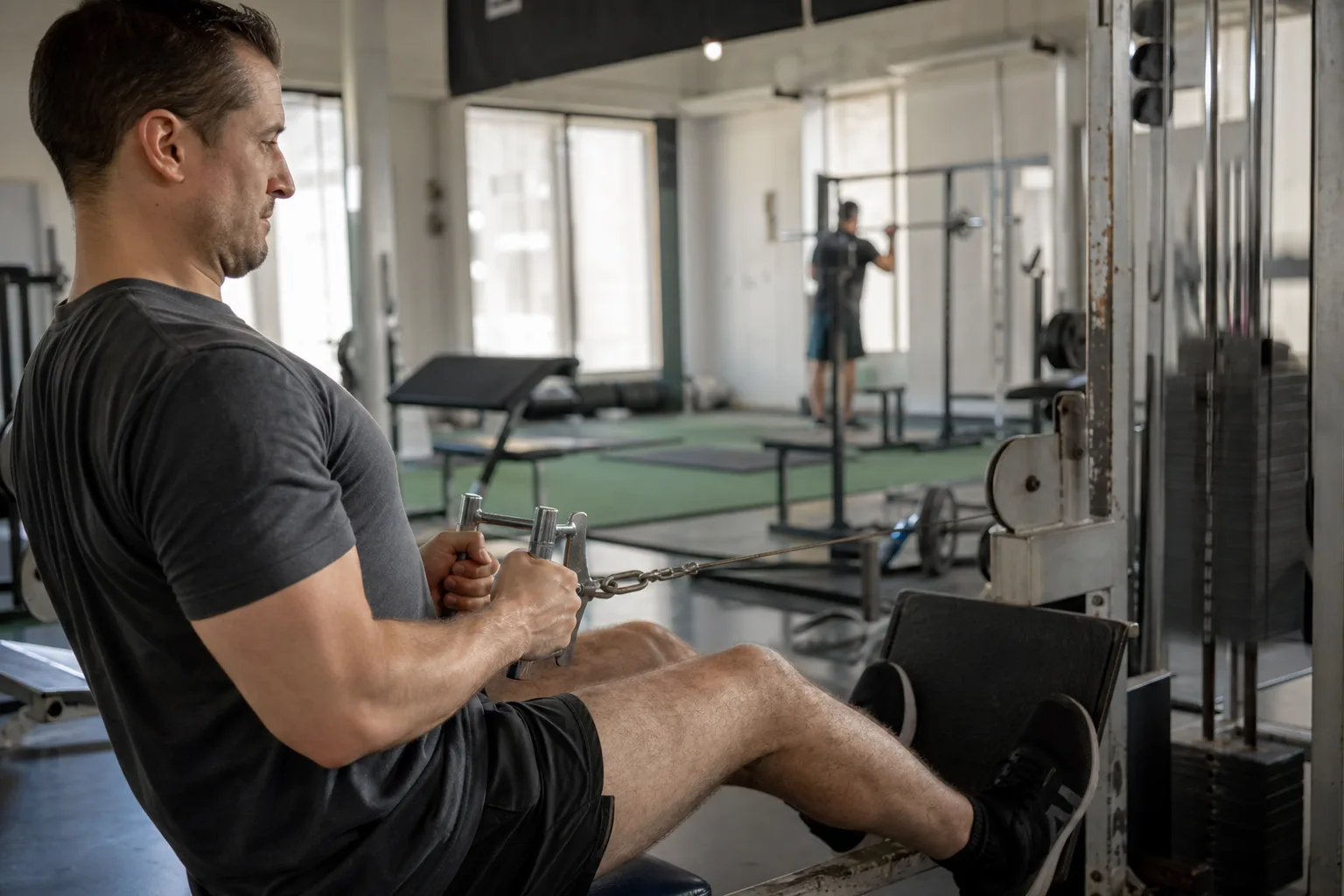
Technique & selection
Muscle Groups: Selection & Technique
Performance education — not medical advice. Stop and seek professional care if you have sharp pain, dizziness, chest pain, or unexplained symptoms.
Exercise selection for chest, back, shoulders, glutes, and lagging groups — performance education for healthy lifters, not injury treatment or clinical rehab prescriptions.
Selection principles
Muscle-group training on Muslex means choosing movements that load the target tissue through a useful range while you can still progress load or reps over weeks. It does not mean chasing a burn for its own sake, copying influencer exercise lists, or treating sharp joint pain as “just weakness.”
Healthy-adult resistance training guidance from ACSM-style position literature emphasizes multi-joint lifts, progressive overload, and technique that you can repeat under fatigue (ACSM progression models; ACSM activity resources). Muslex layers coaching heuristics on top: match the resistance profile to the muscle’s preferred length-tension demands when possible, then add isolation only after the big patterns are covered.
If a movement consistently produces sharp joint pain, numbness, or swelling, stop and seek clinical care. Substituting exercises for comfort is normal coaching; diagnosing tissue injury is not.
Movement-pattern matrix
Think in patterns first, body-part labels second. Patterns transfer across splits and equipment constraints.
| Region (label) | Primary patterns | Useful accessories | Common technique focus | Red flags (stop / clinical) |
|---|---|---|---|---|
| Chest / pressing | Horizontal press; incline press | Fly / pec-deck variants; push-ups | Scapular control; elbow path; controlled eccentric | Sharp anterior shoulder pain; instability sensations |
| Back / pulling | Horizontal row; vertical pull | Face pulls; straight-arm pulldown | End-range squeeze without shrugging into neck pain | Radiating arm pain; unexplained numbness |
| Shoulders | Overhead press; row support | Lateral raises; rear-delt work | Raise path that keeps tension on delts, not traps only | Sharp impingement-like pain under load |
| Glutes / hinge & squat | Squat; hip hinge; lunge / split squat | Hip thrust / bridge; abduction work | Hip extension ownership; knee tracking comfort | Sharp hip/knee pain; giving-way episodes |
| Arms / calves | Support from pull/press | Curl / extension; calf raise | Full controlled ROM; avoid momentum ego sets | Tendon sharp pain that worsens session to session |
Decision list for lagging regions
Deep dives: upper chest · side delts · glutes · isolation vs compound.
- Confirm the gap is real — photos, strength logs, or symmetrical performance — not mirror lighting anxiety alone.
- Check weekly hard sets for that region versus easy recovery. Many “lagging” muscles are under-stimulated relative to favorites. See sets per muscle group.
- Improve angle and stretch before adding five random isolation moves. Incline for upper chest bias, torso angle for side delts, stance and torso for glute bias.
- Place priority work earlier in the session while quality is high, especially on shorter busy-day workouts.
- Hold the experiment for a block (6–8 weeks) with logged loads. If joints complain, regress range or exercise and seek care if needed.
Compounds first, isolation second
Compound lifts give you systemic progressive overload and practice of transferable skills. Isolation is a scalpel: useful for bringing up a region once the weekly foundation exists. A chest day made of only light flyes usually fails intermediate strength and hypertrophy goals; a program with presses plus one or two accessories usually works better.
Equipment constraints (home dumbbells, hotel gyms) still follow the same logic: pick the heaviest progressive pattern available, then add isolation. Structure still matters — link back to How to choose a workout split so you are not inventing a bro-split that you cannot recover from.
Technique cues that actually transfer
Prefer cues you can check under fatigue: controlled tempo, consistent depth or ROM targets, and stopping sets when form breaks rather than when the ego wants one more ugly rep. RPE tools help here — RPE training: what RPE 8 means leaves room for clean reps.
Film a working set monthly from a consistent angle. Compare elbow path on presses, torso angle on rows, and hip position on hinges. Small technique debt compounds into plateaus that look like “bad genetics.”
Consumer fitness safety primers such as MedlinePlus exercise and physical fitness reinforce gradual progression and pain awareness. Muslex stays on the performance-education side of that line.
Connecting selection to weekly volume
Exercise choice without volume planning is incomplete. A perfect lateral-raise cue still fails if you only do it once every ten days. Pair this pillar with frequency guidance (how often to train each muscle) and recovery realism (recovery pillar, DOMS guide).
When adding isolation for a lagging area, add one to two hard weekly sets at a time and watch sleep, joint feel, and performance on your main lifts. More is not automatically more muscle — it is sometimes just more fatigue.
Region notes for common goals
Upper-chest emphasis usually means more work at incline angles and careful shoulder-friendly pressing, not endless flat bench volume alone. Side-delt growth typically needs dedicated abduction work with controlled ROM because pressing alone under-stimulates that region for many lifters. Glute-focused blocks often combine a squat or split-squat pattern, a hinge, and a hip-extension accessory, progressed for weeks rather than swapped every session.
Back width and thickness are different feelings in the gym: vertical pulls bias lat lengthened positions for many people, while rows drive mid-back and elbow-flexion cooperation. You do not need perfect anatomy jargon to train; you need repeatable setups and progressive logs. If a “mind-muscle connection” cue helps you keep tension without shrugging into the neck, use it. If it becomes an excuse to lift toy weights forever, return to progressive compounds.
Shoulder health literacy for lifters is mostly about gradual exposure and skipping sharp pain — not diagnosing rotator-cuff pathology from a blog. Pair pressing with pulling volume across the week, and keep overhead work inside recoverable RPE. Cross-check structure so you are not pressing heavy five days while rarely rowing.
Exercise selection rules that scale
Choose one heavy pattern and one accessory pattern per major muscle most weeks. Heavy means you can overload for months: squat or hinge, horizontal press, vertical or horizontal pull. Accessories fill gaps — lateral raises for side delts, curls for elbow flexors, calf work if you care about calves. Swap accessories when joints complain; keep the heavy pattern stable so progression stays visible.
Lagging upper chest or side delts usually need dedicated hard sets with honest stretch and tension, not endless program hopping. Film a set, check range of motion, then add recoverable volume before inventing exotic machines. Cross-link the muscle pages under this hub; selection quality beats programme hopping.
FAQ
Do I need a separate day for every muscle?
No. Most lifters can cover regions across full body, upper/lower, or PPL. Isolation can be sprinkled into those days.
Are machines worse than free weights?
Not categorically. Machines can make progressive overload safer or more convenient for some joints. Free weights often win for transferable skill. Mix based on goals and comfort.
Should I stretch a muscle to make it grow?
Loaded stretch within a controlled exercise ROM can be useful. Passive stretching alone is not a hypertrophy program. Persistent pain with stretching is a clinical boundary.
What if one side is weaker?
Unilateral work, starting with the weaker side, and matched reps are common coaching tactics. Sudden neurological symptoms are clinical — do not self-diagnose.
Safety boundary
- This page assumes you are a generally healthy adult cleared for resistance training.
- Persistent joint pain, numbness, swelling, chest pain, fainting, or post-injury issues: see a qualified clinician — Muslex does not diagnose or treat.
References
- ACSM — Progression models in resistance training for healthy adults.
- ACSM — Physical activity guidelines resources.
- Schoenfeld et al. — Weekly volume dose-response for hypertrophy (PubMed 27433992).
- Schoenfeld et al. — Training frequency and hypertrophy (PubMed 27102172).
- MedlinePlus — Exercise and physical fitness.
- Editorial note: Summaries are for education on training performance. Individual response varies; this is not a clinical protocol.
Related: How to choose a workout split · Progressive overload for lifters · Ask Muslex