Guide · Training structure
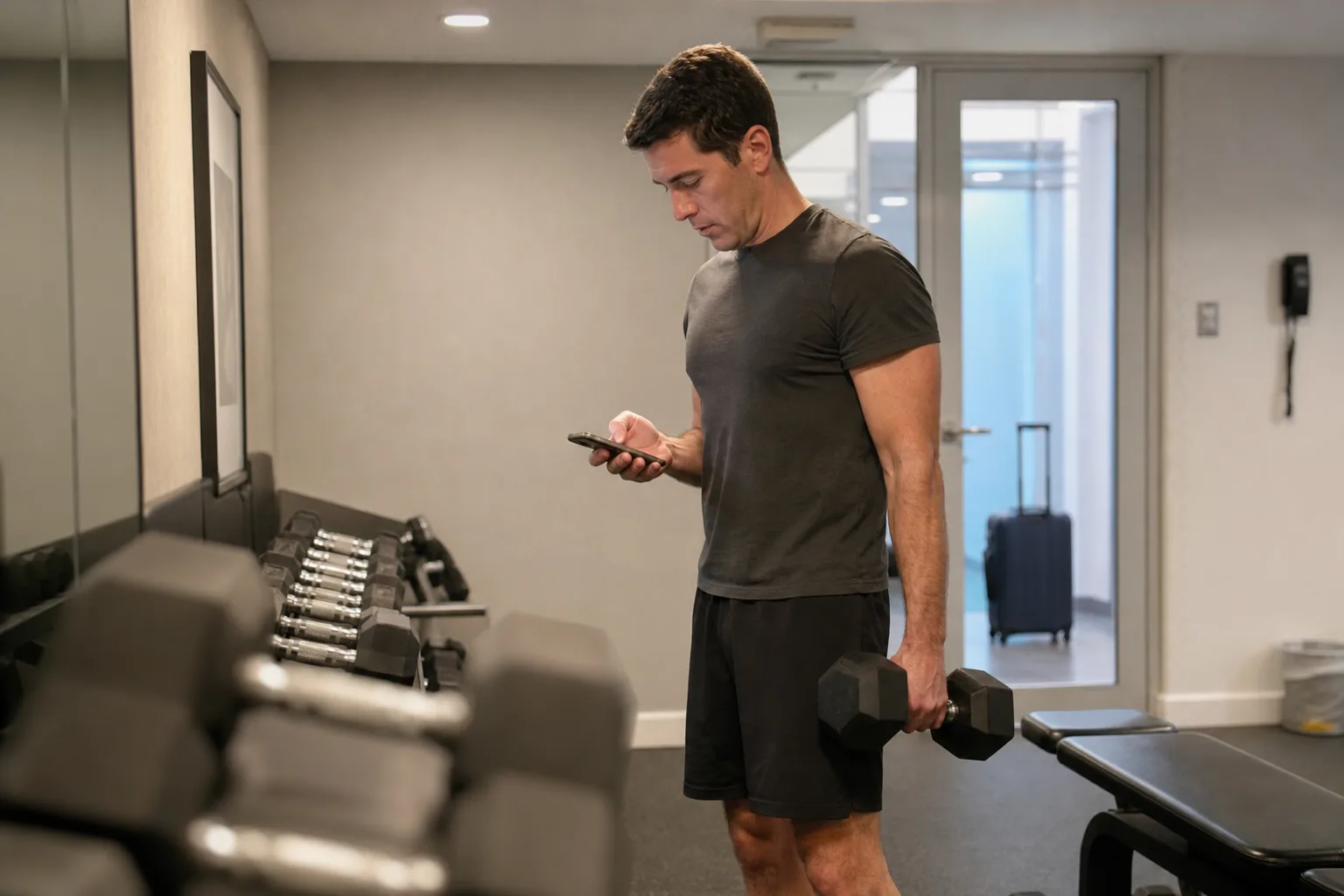
Hotel Gym Dumbbell Workouts to Maintain Muscle on Work Trips
Performance education — not medical advice. Stop and seek professional care if you have sharp pain, dizziness, chest pain, or unexplained symptoms.
Direct answer
On short trips, maintain training with two to four compact sessions built around a knee-dominant exercise, hinge, push and pull. Use slower tempo, unilateral work or higher repetitions when the heaviest dumbbells are lighter than usual.
- Core patterns
- Squat, hinge, push and pull.
- Light weights
- Use unilateral work, tempo and repetitions.
- Trip goal
- Maintain the habit—not force personal records.
Quick answer
A hotel gym with a few dumbbell pairs is enough to maintain muscle for most trips lasting days to a couple of weeks. Maintenance needs less volume than building phases. Your job is to keep practising major patterns with challenging sets, protect sleep in strange beds, and avoid inventing a chaotic new program every city. When you return home, resume progressive overload rather than punishing “catch-up” weeks.
If the hotel only has 10 kg / 20 lb dumbbells, use unilateral work, slower eccentrics, pauses, and higher effort (closer to RPE 8–9) so sets still matter. If there is a cable stack or a decent bench, use them — do not romanticise suffering with tiny bells when better tools exist in the same room.
Trip-length decision table
| Trip length | Goal | Session target | Notes |
|---|---|---|---|
| 1–3 nights | Stay loose / optional | 0–2 short sessions | Walking + one full-body set is fine |
| 4–10 nights | Maintain | 2–4 sessions | Full-body templates; log roughly |
| 2–4 weeks | Maintain / mild build | 3 sessions/week | Treat like a temporary home gym |
| Longer relocation | Rebuild structure | Return to normal split | Find a proper gym if possible |
45-minute hotel full-body (steps)
- Warm-up: 3–5 minutes easy bike/walk + empty-bell rehearsal sets.
- Goblet or split squat — 3 hard sets.
- Single-arm row — 3 hard sets each side.
- Floor or bench press — 3 hard sets.
- Romanian deadlift or hip hinge — 2–3 hard sets.
- Optional: overhead press, rear-delt raise, or suitcase carry — 2 sets.
- Leave. Do not add a random 20-exercise finisher that wrecks tomorrow’s meetings.
Keep most sets with 1–2 reps in reserve unless loads are tiny — then you may need closer to failure to compensate. Protein timing panic is unnecessary on the road; hit daily protein somehow (eggs, dairy, lean meats, convenient shakes if you use them). See anabolic window & protein timing.
Travel recovery boundaries
Jet lag and short sleep reduce performance. Cut hard sets rather than grinding ego loads. Alcohol-heavy client dinners blunt recovery — one night will not erase months of training, but stacked late nights plus skipped meals will. Mild DOMS after a new hotel setup is normal; sharp joint pain is not — stop and seek care if needed. For night-shift or odd hours, pair this page with building muscle on night shift and the sleep pillar.
Sample 3-night vs 10-night plans
On a short three-night trip, one full-body session plus daily walking is enough for most lifters who already train consistently at home. Treat the session as skill and stimulus maintenance: squat or split squat, a row, a press, a hinge, then leave. Do not invent a bodybuilding “vacation specialization” that leaves you sore for client meetings.
On a 10-night trip, schedule three compact sessions — for example Monday, Thursday, Saturday — using the same movement patterns with small logbook notes on your phone. If the dumbbell rack tops out early, emphasise single-leg work, slower eccentrics, and paused reps. If the hotel has a cable column, add face pulls or pushdowns for shoulders and elbows that feel better with controlled paths. Keep protein roughly on target using convenient foods; exact timing matters less than daily totals. When you fly home, resume your normal progression the first fresh training day rather than adding random “make-up volume” that spikes injury risk.
Busy professionals often fail travel training by all-or-nothing thinking: either a perfect 90-minute session or nothing. The winning pattern is boring and repeatable. If jet lag is brutal, swap a hard session for mobility and an easy walk, then train the next day. Maintenance is still a win.
Frequently asked questions
Will I lose muscle on a one-week work trip?
Unlikely if you keep protein decent and do a couple of challenging sessions — or even just stay generally active. Muscle loss usually needs longer underfeeding and inactivity.
What if the hotel gym is crowded or tiny?
Use a compact full-body template, share racks politely, or train early. Bodyweight plus a backpack can substitute in a pinch for a day or two.
Should I try for PRs on the road?
Usually no. Maintain quality sets. Save max attempts for familiar equipment and stable sleep.
Can I do cardio only while travelling?
Cardio helps health and stress, but for muscle maintenance include some hard resistance sets when possible.
Related guides & pillars
- How to choose a workout split
- Build muscle with home dumbbells
- Rest days for lifters
- Night shift muscle gain
- Recovery pillar
Safety boundary
- This guide assumes you are a generally healthy adult cleared for resistance training.
- Persistent joint pain, numbness, swelling, chest pain, fainting, or post-injury issues: see a qualified clinician — Muslex does not diagnose or treat.
- Supplement or alcohol sections are performance education only — not medical nutrition therapy or addiction advice.
References
- Progression Models in Resistance Training for Healthy Adults — ACSM position stand — 2009.
- Effects of resistance training frequency on measures of muscle hypertrophy — Schoenfeld et al., Sports Med — 2016.
- Dose–response of weekly resistance training volume — Schoenfeld et al., J Sports Sci — 2017.
- Editorial note: Summaries are for education on training performance. Individual response varies; this is not a clinical protocol.
Pillar: How to choose a workout split · Disclaimer · Inquiry